
Why Water Ingress Is the Silent Threat to Concrete Structures
Concrete is often perceived as a permanent and maintenance-free construction material. However, many property owners, developers, engineers, and facility managers discover that concrete structures can deteriorate much sooner than expected when exposed to continuous moisture intrusion.
Water ingress is one of the leading causes of structural deterioration in buildings and infrastructure throughout the Philippines. With heavy rainfall, high humidity, flooding, and coastal exposure, concrete structures face constant challenges from water penetration.
At AVA Concrete Protection, we help owners eliminate water ingress, corrosion, and premature concrete deterioration through advanced concrete waterproofing solutions designed to protect structures from within.
Understanding Water Ingress in Concrete Structures

Although concrete appears solid, it contains microscopic pores and capillaries that allow water to penetrate over time. Once water enters the concrete matrix, it can transport harmful contaminants such as chlorides, sulfates, and carbon dioxide deep into the structure.
Common areas vulnerable to water ingress include:
- Basements
- Elevator pits
- Water tanks
- Roof decks
- Retaining walls
- Tunnels
- Parking structures
- Foundation slabs
- Podium decks
- Wastewater facilities
Without proper protection, moisture infiltration can initiate a chain reaction of deterioration that becomes increasingly expensive to repair.
How Water Ingress Leads to Concrete Corrosion

One of the most serious consequences of water ingress is reinforcement corrosion.
Steel reinforcing bars are naturally protected by the highly alkaline environment inside concrete. However, when water and aggressive chemicals penetrate the structure, the protective environment gradually breaks down.
The result is corrosion of the reinforcing steel.
Corroding steel expands significantly in volume, creating internal pressure that causes:
- Concrete cracking
- Delamination
- Spalling
- Rust staining
- Reduced structural capacity
- Increased maintenance costs
In many cases, the visible crack is only the symptom. The real problem is occurring deep inside the concrete.
The Cost of Premature Concrete Deterioration

Premature concrete deterioration affects more than just appearance.
Property owners often face:
Increased Maintenance Expenses
Repeated waterproofing repairs, patching works, and coating replacements can become a recurring operational expense.
Tenant and Occupant Complaints
Leaks in basements, parking structures, commercial buildings, and residential developments can negatively affect user experience and property value.
Business Disruption
Repair activities often require area closures, tenant coordination, and operational interruptions.
Reduced Asset Value
Deteriorating concrete can impact long-term property valuation and increase future rehabilitation costs.
The most cost-effective strategy is to prevent deterioration before it begins.
Concrete Waterproofing Solutions That Protect from Within
Traditional waterproofing systems often rely on surface-applied membranes that can be punctured, damaged, or deteriorate over time.
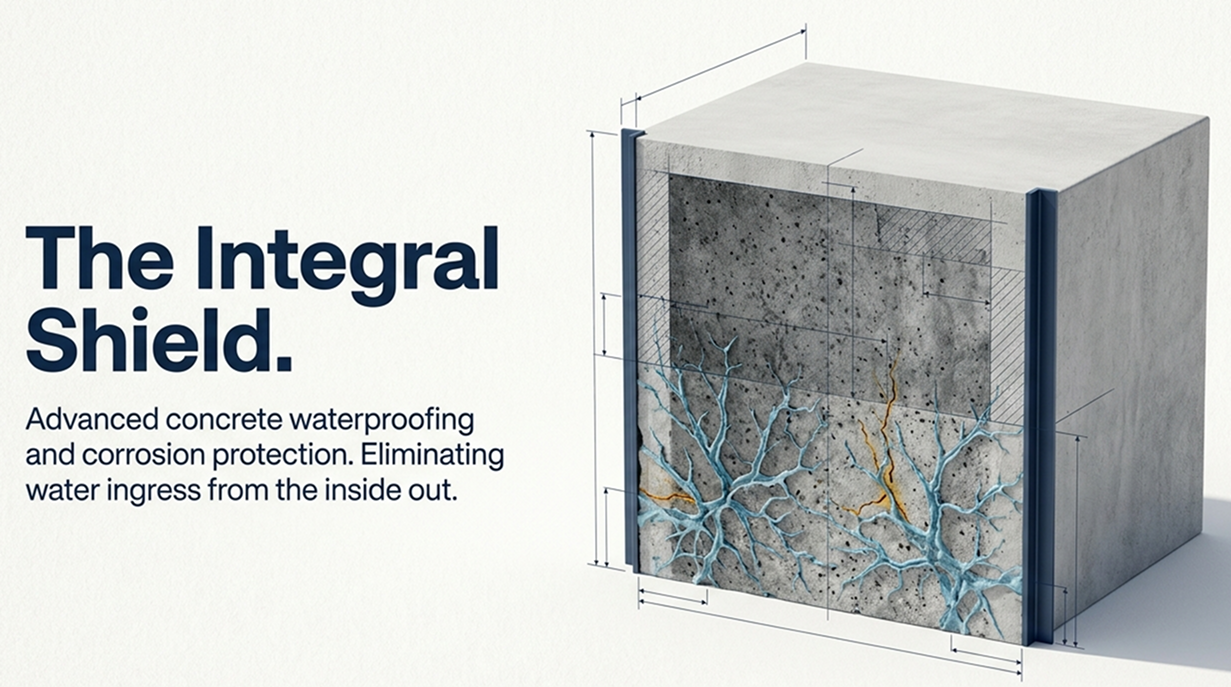
A more durable approach involves integral concrete waterproofing.
Integral waterproofing technologies become part of the concrete itself, providing embedded protection throughout the structure.
Benefits include:
- Permanent waterproofing protection
- Reduced dependence on surface membranes
- Protection against hydrostatic pressure
- Resistance to chloride penetration
- Reduced maintenance requirements
- Enhanced service life of structures
This approach is particularly valuable for structures where future access for repairs is difficult or costly.
Why Crystalline Waterproofing Is Effective

Crystalline waterproofing technology works by reacting with water and unhydrated cement particles inside the concrete.
This reaction forms insoluble crystals that fill pores, capillaries, and microcracks.
As a result, the concrete becomes significantly less permeable while maintaining its ability to breathe.
Key advantages include:
- Self-sealing of minor cracks
- Long-term waterproofing performance
- Integral protection throughout the concrete mass
- Resistance to hydrostatic pressure from both positive and negative sides
- Improved durability in aggressive environments
Unlike surface coatings that protect only the exterior, crystalline waterproofing becomes part of the concrete structure.
Applications for Concrete Waterproofing Solutions in the Philippines
Concrete waterproofing solutions are widely used in:
Commercial Buildings
Protect basements, podium decks, roof decks, and parking structures from moisture-related damage.
Residential Developments
Improve long-term durability while reducing future maintenance concerns.
Industrial Facilities
Protect critical infrastructure exposed to water, chemicals, and aggressive environments.
Water and Wastewater Structures
Provide durable protection for tanks, reservoirs, and treatment facilities.
Infrastructure Projects
Enhance the service life of bridges, tunnels, retaining walls, and transportation facilities.
Why Prevention Is Better Than Repair

Many owners invest in waterproofing only after leaks become visible. By this stage, water may have already penetrated deep into the structure and initiated corrosion.
Preventive concrete protection offers several advantages:
- Lower lifecycle costs
- Reduced repair frequency
- Longer service life
- Improved asset performance
- Reduced risk of structural deterioration
- Greater confidence in long-term durability
Protecting concrete during construction is often far less expensive than repairing damaged structures years later.
How AVA Concrete Protection Helps Owners Protect Their Investments

At AVA Concrete Protection, we help owners, developers, consultants, contractors, and infrastructure stakeholders implement proven concrete waterproofing solutions that address the root causes of deterioration.
Our objective is simple:
Eliminate water ingress, prevent corrosion, and extend the service life of concrete structures.
By incorporating advanced waterproofing technologies during construction and rehabilitation projects, owners can significantly reduce future maintenance costs while improving the long-term performance of their assets.
Conclusion
Water ingress is one of the primary drivers of concrete corrosion and premature structural deterioration. Left unaddressed, it can lead to costly repairs, operational disruptions, and reduced asset value.
Investing in effective concrete waterproofing solutions helps protect structures against moisture intrusion, reinforcement corrosion, and long-term deterioration.
For owners seeking durable, low-maintenance protection, integral waterproofing technologies provide a proactive solution that safeguards concrete from the inside out.
Protect Your Concrete Investment Today
If you are planning a new project or rehabilitating an existing structure, AVA Concrete Protection can help you implement long-term waterproofing solutions that reduce maintenance costs and maximize structural durability.
