
When planning a new construction project, selecting the right waterproofing system is one of the most critical decisions for long-term durability. Water intrusion can lead to concrete deterioration, steel corrosion, mold growth, and costly repairs. Developers, engineers, and contractors often compare Xypex vs traditional membrane waterproofing to determine the best solution.
While traditional membrane systems have been widely used for decades, crystalline waterproofing technologies like Xypex are transforming how structures are protected from water damage. Understanding the strengths and limitations of each system can help project owners make informed decisions.
Understanding Traditional Membrane Waterproofing
Traditional membrane waterproofing involves applying an external barrier over concrete surfaces to block water penetration. Common membrane systems include:
- Bituminous membranes
- PVC membranes
- Polyurethane coatings
- EPDM rubber membranes
These membranes act as a physical shield between the structure and moisture.
Advantages of Traditional Membrane Waterproofing:
- Familiar to many contractors
- Immediate water barrier
- Suitable for certain roof and exposed applications
- Available in multiple material options
Limitations:
- Vulnerable to punctures and tears
- Can degrade over time due to UV exposure or soil movement
- Installation quality is highly dependent on workmanship
- Requires regular maintenance and repairs
- Difficult to repair once buried or covered
What Is Xypex Crystalline Waterproofing?
Xypex is an advanced waterproofing technology that uses crystalline chemicals to penetrate deep into concrete. When applied or added to the concrete mix, Xypex reacts with moisture and unhydrated cement particles to form insoluble crystals within the concrete pores and capillaries.
Benefits of Xypex:
- Becomes a permanent part of the concrete
- Self-seals minor cracks over time
- Resists hydrostatic pressure from both positive and negative sides
- Protects against chemical attacks
- Reduces long-term maintenance costs
- Extends the lifespan of concrete structures
This makes Xypex particularly effective for:
- Basements
- Foundations
- Water tanks
- Parking structures
- Roof decks
- Tunnels
- Wastewater facilities

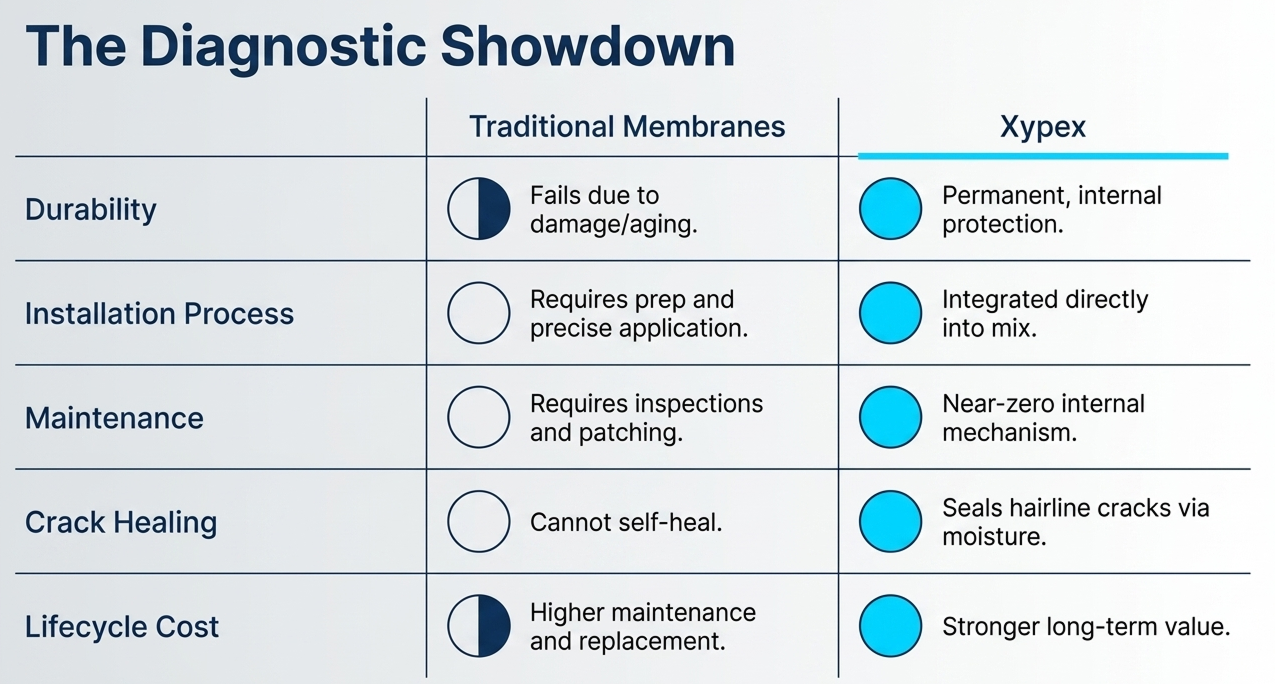
Xypex vs Traditional Membrane Waterproofing: Key Differences
1. Durability
Traditional membranes can fail due to physical damage or aging. Xypex, however, remains active within the concrete and provides permanent waterproofing.
Winner: Xypex
2. Installation Process
Membrane systems require surface preparation, precise application, and protection layers. Xypex admixtures can be integrated directly into the concrete mix, simplifying installation.
Winner: Xypex
3. Maintenance
Membranes often require inspections, patching, or replacement. Xypex significantly reduces maintenance due to its internal protection mechanism.
Winner: Xypex
4. Crack Healing
Membranes cannot self-heal when damaged. Xypex technology can seal hairline cracks when moisture is present.
Winner: Xypex
5. Cost Over Lifecycle
Membranes may have lower initial costs but often incur higher maintenance and replacement expenses. Xypex provides stronger long-term value.
Winner: Xypex
Why Xypex Is Ideal for New Construction Projects
For developers seeking sustainable and durable solutions, Xypex offers several strategic advantages:
Enhanced Structural Integrity
By waterproofing from within, Xypex preserves concrete strength and minimizes deterioration.
Faster Construction Timelines
Admixture applications reduce labor-intensive membrane installations.
Sustainability Benefits
Xypex reduces the need for replacement materials, lowering environmental impact.
Long-Term ROI
Reduced maintenance and extended building lifespan improve investment returns.
When Traditional Membranes May Still Be Useful
Although Xypex is superior for internal concrete waterproofing, membrane systems may still be suitable for:
- Green roofs
- Temporary waterproofing applications
- Certain exposed deck surfaces
- Specialized architectural designs
In some cases, combining systems may provide layered protection.
Final Verdict: Xypex vs Traditional Membrane Waterproofing
When comparing Xypex vs traditional membrane waterproofing, Xypex consistently delivers superior long-term protection, durability, and value for most new construction projects.
Traditional membranes may serve specific applications, but for permanent concrete protection, Xypex offers:
- Internal waterproofing
- Self-healing capability
- Reduced maintenance
- Extended structural lifespan
- Better ROI
For builders focused on quality, sustainability, and durability, Xypex represents the future of waterproofing technology.

Conclusion
Choosing the right waterproofing system can significantly impact the lifespan and success of any new construction project. While traditional membranes provide short-term barriers, Xypex’s crystalline waterproofing technology offers permanent, integrated protection that aligns with modern construction demands.
For developers and contractors seeking dependable waterproofing solutions, Xypex provides a smarter, more resilient investment.
